Every new field, rule and screen waits on a vendor.
The people who know the process cannot change the system that runs it. OpenCore MES lets them.
Everything is a design.
Designed in the browser, never written into the product.
- Objects. Lots, machines, work orders: fields, states, roles.
- Screens and transactions. Station screens, move-in, track-out, built from blocks.
- Lists typed into. A screen's table edits its records where they stand, a cell at a time, through the same policies, rules and approvals as their form.
- Conditions in words. Built from the fields, read back in plain words; no code.
- Copy and change. Any design is the start of the next.
- Named queries. The queries the plant relies on, approved like the rest.
- Numbered for you. Certificates, receipts, entries: a field the platform numbers with no gap, per year or per site.
- A designer for your work. A suite can bring a designer shaped to its domain; the whole one stays for those who need it.
- An AI that drafts. Describe it; it drafts the change. AI
In the demo: The designer
// scrap_within_lot.js
export default function scrap_within_lot(ctx) {
  if (ctx.data.scrap_qty > ctx.record.qty)
    throw Object.assign(
      new Error("More scrap than the lot holds."),
      { field: "scrap_qty" });
  return ctx;
}
The object holds its rules.
A short function in the object's design, run everywhere.
- One place to lookEvery rule beside the fields it guards.
- Warned as people typeThe form runs it before anything is sent.
- Enforced on every saveScreens, services, imports: nothing gets around it.
- Tested before approvalIts test cases run before a change can be submitted.
- Findings that lead to the fixEach one opens the place to put it right, or hands it to the AI.
OEE, quality and SPC are models, not modules.
Built from objects, rules and screens, shaped to how your plant works. A new formula is a change, not a vendor release.
OEE
Downtime by reason, counts by shift, a scheduled service works it out.
QMS
Deviations, NCRs, CAPA: their states, signatures and links to the lot.
SPC
Limits checked on every reading; out of limits sets off a plan.
In the demo: SPC at the metrology station
Routes and plans, drawn and approved.
How a lot goes through the line, and what happens when a reading falls out of limits, on one canvas.
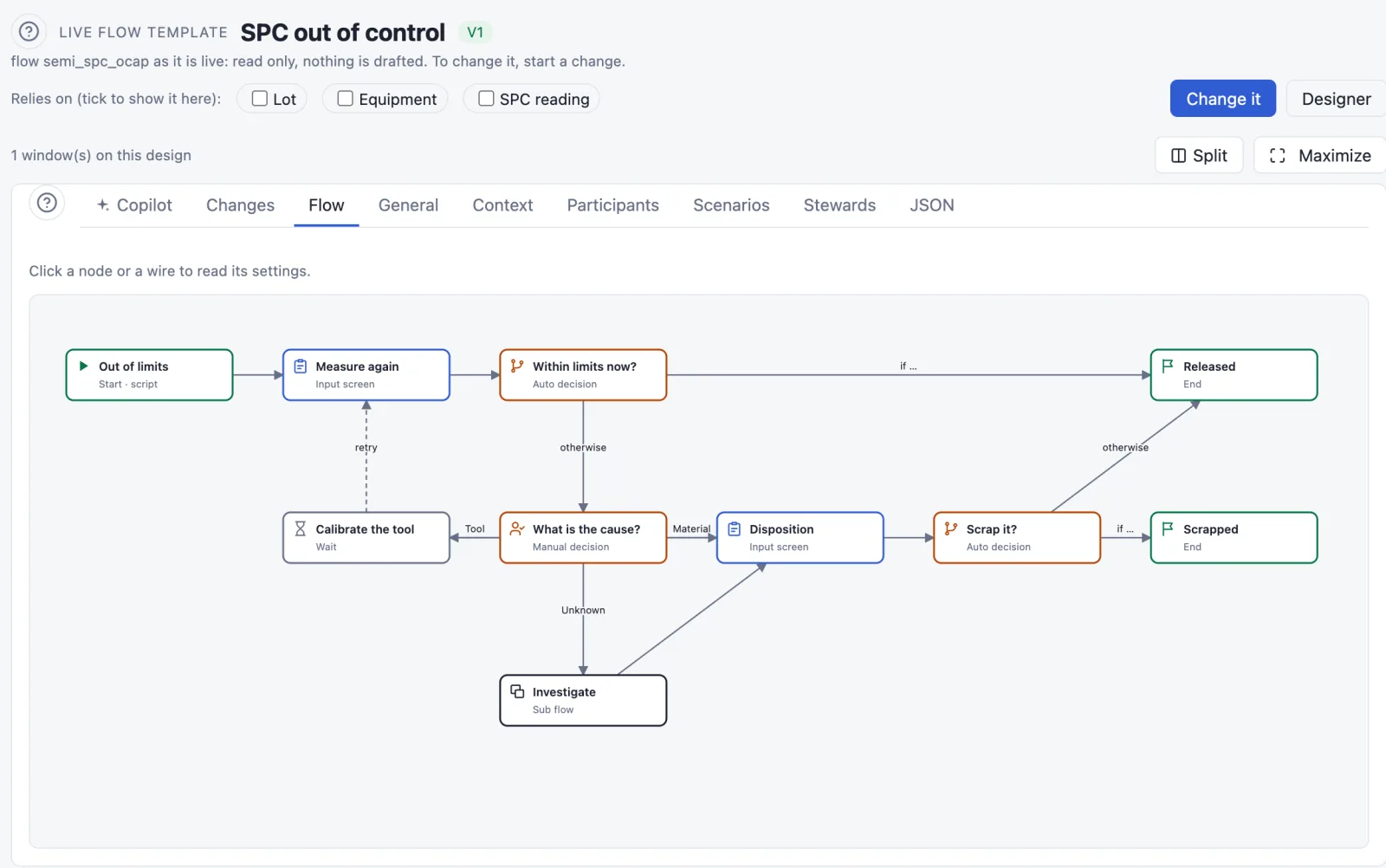 An SPC out-of-control plan, live on the demo.
Routes
Each step offers its transactions; the rest are refused.
Plans
Set off by a reading, a tool down or a date; each step waits for its people.
Proved first
Scenarios walk a lot through it in a sandbox before approval.
In the demo: The back-end route An out-of-control plan
Designed together, in one change.
Two engineers on the same change see each other's work as it is saved, seconds apart.
Co-designers
The author of a change names who designs it with them; each edits the same draft.
Each other's edits, as they land
A draft saves itself two seconds after the last edit and appears on the others' screens.
Nobody overwritten
A save made on an older copy is refused, naming who saved; you see who else has the change open.
Whoever designed a change can neither review nor approve it. How changes go live
Each team, its own space.
The MES team keeps the plant's objects and routes; Operations, Quality or a suite's people design their own, on the same platform.
A space per team
Its designers, and who reviews its changes, set in People & departments through an approved change.
Read by all, changed by its own
Everyone reads every design. Another team's is changed by asking for it, with a request for change.
A filter on the designer's home
My spaces, or one team's: each design tagged with the space it belongs to.
Past the plant floor: a performance review, as a model.
Goals, a mid-term, a calibrated final rating and a signed acknowledgement, built from the same parts as a lot. No code added to the platform.
Goals that weigh 100
The employee sets them; the manager agrees them or sends them back with a note. The mid-term and the final open when HR moves the cycle on.
Sealed until calibrated
Each goal scored, the weighted score worked out. The employee sees it only once the manager's department, and a panel at either end of the scale, have signed it.
Acknowledged, signed
The employee signs that they have read it, agreeing or not; a disagreement waits on HR's board.
A worked example with its designs, run end to end by the test pipeline, in a browser too. A cabinet shop and an employee cooperative are others: same parts, another trade.
Designed. Now approve it.
Nothing a designer or the AI makes reaches the plant until people sign.